PICANTE!
| Overview | The Challenge | Partners | Peppers | Team Science | Education |
International Partners
Panama

The Gorgas Memorial Institute for Health Studies (GMI) in Panama City, Panama, is a public institution that works closely with the Ministry of Health to improve the health of Panama and Central America. As a premier pathobiology research institute, its mission is to develop health research in Panama, fulfill the functions of a national public health laboratory, and provide education to health care workers throughout the region.
Ecuador
Center for Research on Health in Latin America (CISeAL) is a collaboration between the Pontifical Catholic University of Ecuador and the Infectious and Tropical Diseases Institute (ITDI) at Ohio University that develops biomedical and biological research, epidemiological surveillance, and education and training programs in Ecuador.
Ecuador
Museo de Zoología QCAZ, Pontificia Universidad Católica del Ecuador, División de Mastozoología, is dedicated to scientific research and the preservation and dissemination of information on the mammals of Ecuador. It houses the largest collection of Ecuadorian mammals.
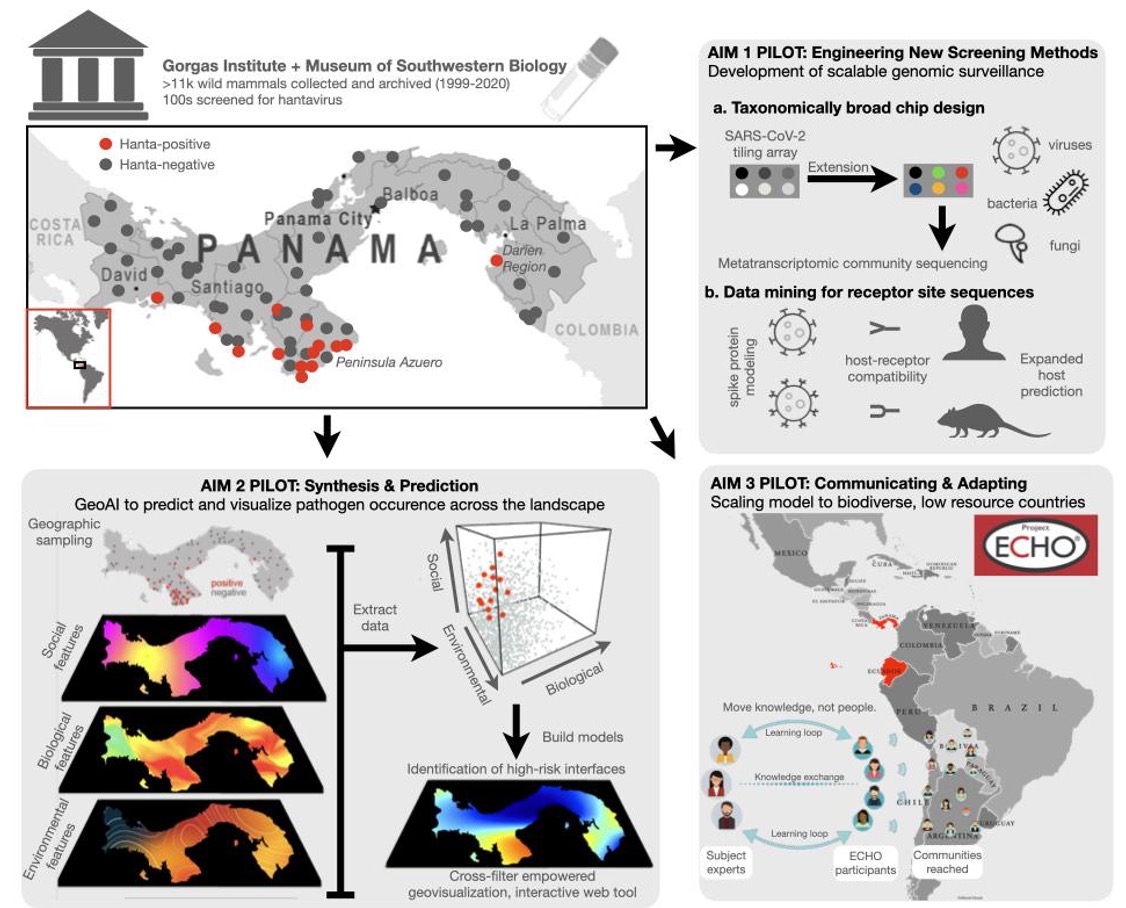
A major focus of PICANTE is capacity building, workflow scalability, and dissemination across borders. In collaboration with Project ECHO and the virtual network Museums and Emerging Pathogens in the Americas (MEPA) , the Center is expanding wildlife sampling strategies and developing a comprehensive, decentralized network of local biorepositories for pathogen surveillance. We focus on changing environmental interfaces and use archived collections to examine changes in host reservoirs and pathogen communities across space and time, helping predict conditions that stimulate pathogen emergence. Interoperable, open data ensure that the Center's products are available and accessible to stakeholders ranging from local communities to international public health agencies. Advances in sequencing, bioinformatics, visualization, and data interpretation provide affordable and scalable methods for pathogen detection, discovery, and monitoring. Through the collaborative MEPA network, PICANTE promotes international adoption of these approaches by offering virtual education, capacity-building, and collaborative problem-solving programs for biorepositories throughout the Americas. Together, these efforts standardize biodiversity exploration and strengthen connections among local communities, sequencing facilities, bioinformatics resources, public health agencies, and natural resource organizations.